

What Is Merchant Cash Advance?
Merchant Cash Advance is a simple way for businesses to get short-term money when they need quick cash support. It is not a regular business loan. Instead of fixed monthly EMIs, the repayment is linked to your daily business sales.
In a Merchant Cash Advance, a business receives an advance amount based on its past sales. Later, a small part of daily sales is used to repay that amount. This makes it useful for businesses that have regular daily income but face temporary cash flow problems.
Many small businesses use a Merchant Cash Advance when they need funds for urgent needs like buying stock, paying suppliers, or managing short-term expenses. Since the repayment depends on sales, the pressure of fixed monthly payments is lower compared to traditional loans.
A business cash advance works best for businesses that have steady sales through cash, UPI, or card payments. It is mainly designed as short-term funding for business, not for long-term growth or expansion plans.
It is important to understand that Merchant Cash Advance for small business is a quick support option, not a replacement for working capital loans or term loans. Choosing it wisely helps businesses manage cash flow without taking unnecessary long-term risk.
How Does a Merchant Cash Advance Work?
A Merchant Cash Advance works in a simple step-by-step way. It is designed for businesses that have regular daily sales and need short-term cash support.
Step 1: Business Sales Review
First, your business sales are checked. This usually includes recent bank statements and daily sales records. Based on this data, the possible Merchant Cash Advance loan amount is estimated.
Step 2: Advance Amount Is Given
Once approved, the business receives the agreed advance amount. This money can be used for urgent needs like stock purchase, supplier payments, or other short-term business expenses.
Step 3: Repayment Through Daily Sales
In a Merchant Cash Advance, repayment is linked to daily business sales. A small fixed percentage is deducted regularly from sales until the full amount is recovered. This is called the Merchant Cash Advance repayment method.
Step 4: No Fixed Monthly EMI
Unlike traditional loans, there is no fixed monthly EMI. On days when sales are low, the repayment amount is also lower. This makes a Merchant Cash Advance for business easier to manage during slow periods.
Recent Posts
MSME Lending : Value & Volume Up — But What About Rising Delinquencies?
Women-led MSMEs : Progress, Credit Challenges and Future Potential
MSMEs & Skill / Infrastructure Gap: Why Many Small Businesses Still Struggle
How Can I Utilise the Loan Against Property?
Common Mistakes to Avoid When Taking a Loan Against Property in India
Overall, this process helps businesses get short-term funding for business needs without the pressure of fixed repayments. However, it should always be used carefully and only for short-term cash flow support.
Who Should Use Merchant Cash Advance?
A Merchant Cash Advance is suitable for businesses that earn money daily and face short-term cash flow gaps. It works best when a business needs quick support for a limited time, not long-term funding.
A Merchant Cash Advance for small business is commonly used by retailers, traders, restaurants, and service providers who receive regular payments through cash, UPI, or card machines. Since the repayment depends on daily sales, businesses with steady income can manage it more easily.
Businesses that deal with seasonal demand can also benefit from a Merchant Cash Advance for business. For example, when extra stock is needed during festivals or peak seasons, this option helps manage expenses without waiting for long loan approvals.
A Merchant Cash Advance loan is also useful for businesses that may not qualify for traditional loans due to strict eligibility rules. It focuses more on sales performance rather than only credit history.
Overall, Merchant Cash Advance is ideal for businesses that need short-term funding for business operations and have consistent daily sales to support regular repayment.
When Merchant Cash Advance May Not Be the Right Choice
A Merchant Cash Advance is not suitable for every business. It is important to understand when this option should be avoided to prevent future financial stress.
If a business has very low profit margins, a Merchant Cash Advance may create pressure because repayment is linked to daily sales. When margins are thin, even small daily deductions can affect regular operations.
Businesses that need funds for long-term goals, such as expansion, buying large machinery, or setting up a new unit, should not rely on a Merchant Cash Advance loan. This type of funding is meant only for short-term needs, not for long-term planning.
A Merchant Cash Advance for business may also not be the right choice if sales are irregular or unpredictable. Since repayment depends on daily income, inconsistent sales can make cash flow management difficult.
In such cases, traditional options like working capital loans or term loans may be more suitable than a Merchant Cash Advance for small business. Choosing the right funding option helps protect business stability and long-term growth.
Hot Topics
Interest Rates Are Falling
Business Ideas
Business Ideas in Goa
Business Ideas in Rajasthan
Business Ideas in Gujarat
MSME Business Ideas
Merchant Cash Advance vs Working Capital Loan
Many business owners get confused between a Merchant Cash Advance and a working capital loan. Both help with cash flow, but they work in very different ways.
A Merchant Cash Advance provides short-term funding based on daily business sales. Repayment happens through a small portion of daily sales, and there is no fixed monthly EMI. This makes it suitable for urgent and temporary business needs.
A working capital loan, on the other hand, is a regular loan with fixed EMIs and a defined tenure. It is better for businesses that want planned funding for ongoing operations and can handle monthly repayments.
The biggest difference in Merchant Cash Advance vs working capital loan is the repayment method. In a Merchant Cash Advance, repayment changes with sales, while in a working capital loan, the EMI remains the same every month.
A Merchant Cash Advance for business is useful when money is needed quickly for a short period. A working capital loan is more suitable for stable and long-term cash flow management.
Understanding this difference helps businesses choose the right option instead of picking a funding solution that may not fit their needs.
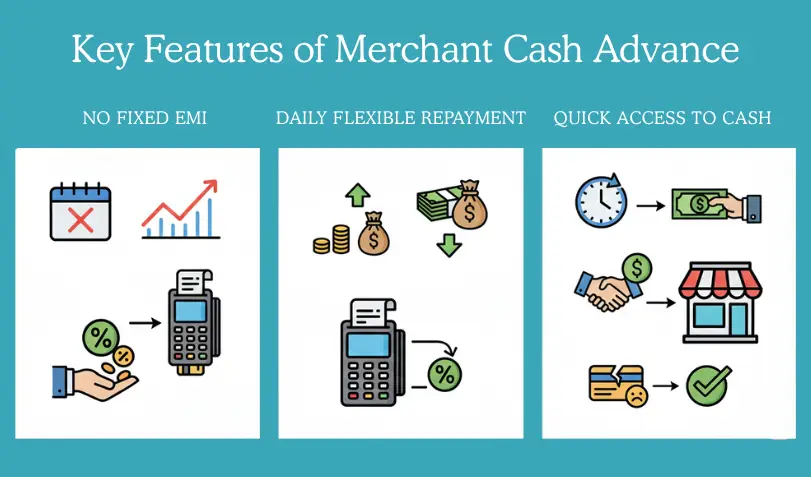
Key Features of Merchant Cash Advance
A Merchant Cash Advance comes with features that make it useful for short-term business needs, especially when quick cash flow support is required.
One key feature of a Merchant Cash Advance is flexible repayment. Since repayment is linked to daily sales, businesses do not have to worry about fixed monthly EMIs.
Another feature of a Merchant Cash Advance loan is that it focuses more on business sales than on strict eligibility rules. This makes it accessible for many small businesses that may find traditional loans difficult.
A Merchant Cash Advance for business is designed for short-term use. It helps manage urgent expenses without locking the business into long-term debt.
For many retailers and traders, a Merchant Cash Advance for small business works as a simple cash flow tool during busy or slow periods.
Overall, Merchant Cash Advance is a sales-based funding option meant to support daily operations, not long-term business expansion.
Benefits of Merchant Cash Advance for Small Businesses
A Merchant Cash Advance offers several benefits for businesses that need short-term cash flow support and have regular daily sales.
One major benefit of a Merchant Cash Advance is quick access to funds for urgent business needs. It helps businesses manage expenses like stock purchase, supplier payments, or short-term operational costs without long waiting periods.
Another benefit of a Merchant Cash Advance for small business is flexible repayment. Since repayment depends on daily sales, businesses do not feel the pressure of fixed monthly EMIs during slow days.
A Merchant Cash Advance for business also supports cash flow management during seasonal demand. When sales increase or expenses rise suddenly, this option helps businesses continue operations smoothly.
For businesses that cannot easily qualify for traditional loans, a Merchant Cash Advance loan works as an alternative funding option based on sales performance rather than only credit history.
Overall, Merchant Cash Advance is helpful when used carefully as short-term funding for business, especially to handle temporary cash flow gaps without creating long-term financial burden.
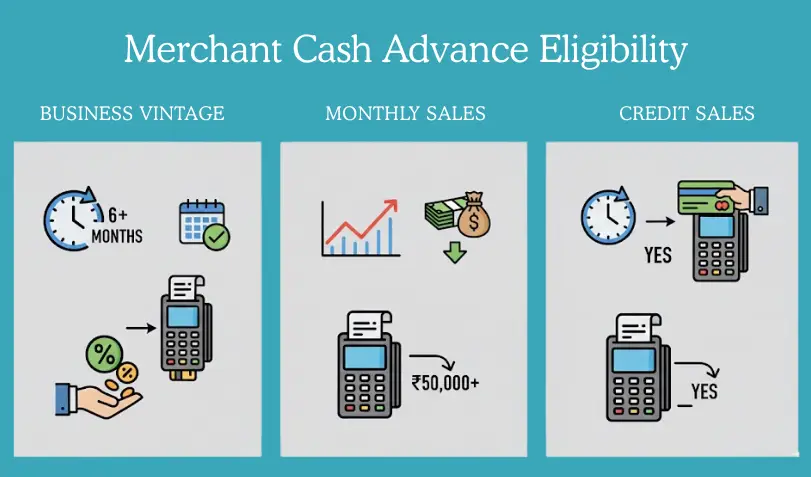
Merchant Cash Advance Eligibility
The eligibility for a Merchant Cash Advance is simple and mostly based on business sales. It is different from traditional loans, where strict rules and long approval processes are common.
A Merchant Cash Advance for business is usually available to businesses that have regular daily sales. This includes sales through cash, UPI, card machines, or bank transfers.
To qualify for a Merchant Cash Advance for small business, the business should be active and running for a minimum period. Lenders generally check recent bank statements to understand sales flow and cash movement.
Another important point in Merchant Cash Advance eligibility is consistent income. Businesses with steady sales are better suited because repayment is linked to daily revenue.
Unlike traditional loans, a Merchant Cash Advance loan does not focus heavily on long credit history or collateral. The main factor is whether the business can support regular repayment through its sales.
Overall, Merchant Cash Advance eligibility is designed to support businesses that need short-term funding for business and have reliable daily income.
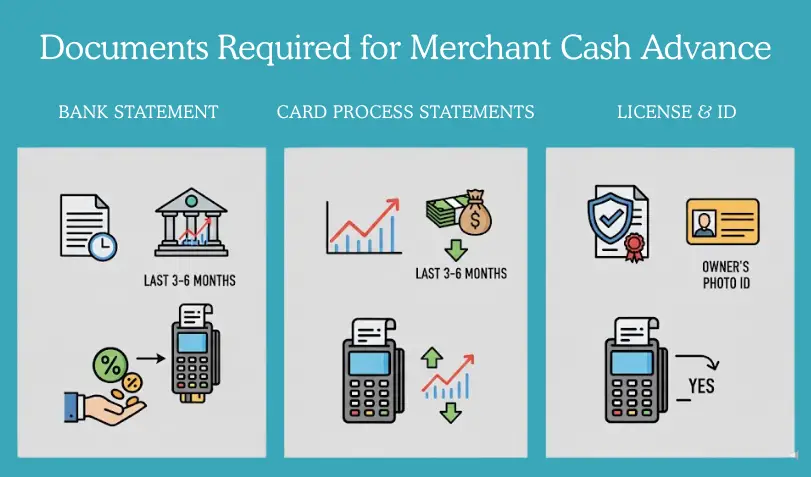
Documents Required for Merchant Cash Advance
To apply for a Merchant Cash Advance, only basic business documents are required. The process is kept simple so that businesses can get short-term funding without long delays.
For a Merchant Cash Advance for business, lenders usually ask for identity and business proof. These documents help verify the business and understand its sales activity.
Common documents required for a Merchant Cash Advance for small business include business PAN, Aadhaar of the owner, and recent bank statements. Bank statements are important because they show daily sales and cash flow.
If the business is registered under GST, GST details may also be requested. This helps in better assessment of the Merchant Cash Advance loan eligibility.
Overall, the document requirement for a Merchant Cash Advance is lighter compared to traditional loans, making it easier for businesses that need short-term funding for business needs.
Common Use Cases :
A Merchant Cash Advance is commonly used by businesses when they face short-term cash needs during daily operations. It helps manage expenses without waiting for long loan approvals.
Many businesses use a Merchant Cash Advance for business to buy stock when demand suddenly increases. This is common during festivals, sales seasons, or special offers.
A Merchant Cash Advance for small business is also used to pay suppliers on time. Timely payments help maintain good supplier relationships and smooth business operations.
Some businesses choose a Merchant Cash Advance loan to handle temporary cash flow gaps, such as delayed customer payments or unexpected expenses.
Overall, Merchant Cash Advance is best used for short-term funding for business needs like inventory purchase, daily expenses, or seasonal cash support—not for long-term investments.
Frequently Asked Questions :
What is a Merchant Cash Advance?
Is Merchant Cash Advance a loan?
How does Merchant Cash Advance repayment work?
Who can apply for a Merchant Cash Advance?
Is Merchant Cash Advance good for small businesses?
Is Merchant Cash Advance risky?
Can Merchant Cash Advance replace working capital loans?
Final Thoughts :
Choosing the right funding option is important for every business. A Merchant Cash Advance can be helpful in some situations, but it may not be the best choice for everyone.
Before applying for a Merchant Cash Advance for business, it is better to understand how it works, how repayment happens, and whether it fits your cash flow needs.
Our team helps businesses compare options and choose the right solution based on real requirements. If you are considering a Merchant Cash Advance for small business, speak with us to understand all aspects clearly.
We focus on honest guidance and practical support so that businesses can make informed decisions about short-term funding for business needs without unnecessary risk.